Author: utscleanenergy

  • University of Technology Sydney visits the Technische Universität Braunschweig

    28 May 2024

    TU Braunschweig has been cooperating with the Australian University of Technology in Sydney (UTS) for more than ten years. In mid-May, Professor James Wallman, Dean of the Faculty of Science at UTS, travelled to Braunschweig for a visit during which both universities signed a cotutelle agreement.

    Founded in its current form in 1988, the University of Technology Sydney is one of Australia’s leading universities. 45,000 students are enrolled across nine faculties. UTS is also home to over 45 research centres and institutes and cooperates closely with partners from industry and government.

    Initial contacts between the two universities were established through a jointly supervised master’s thesis at the Institute of Energy and Systems Process Engineering at TU Braunschweig in 2013. That was followed by joint research publications in battery research and, since May 2023, intensive collaboration with the Centre for Clean Energy Technology at UTS and other partners in the BMBF-funded ScaleH2 research project, which is investigating scalable electrolysers with innovative materials for the production of hydrogen. Both universities also have long-standing contacts and an extremely positive dialogue at management level. As part of a TU9 delegation trip, Professor Angela Ittel, President of TU Braunschweig, visited the long-standing partner university in September 2023. As part of the visit, the two universities signed a Memorandum of Understanding, which forms the basis for further expanding the successful collaboration.

    Partners holding agreement
    Signing of the cotutelle agreement. From left: Dr Ute Kopka, International House, Prof Dr Daniel Schröder, Head of the Institute of Energy and Process Systems Engineering, TU President Prof Angela Ittel, Prof James Wallman, Dean of the Faculty of Science at UTS, and doctoral student Moritz Stahl. Photo: Daniel Götjen/TU Braunschweig


    Cotutelle agreement signed

    The programme for James Wallman’s visit included a tour of the Institute of Energy and Systems Process Engineering, visits to the Centre for Pharmaceutical Process Engineering (PVZ), the Laboratory for Emerging Nanometrology (LENA), the Braunschweig Centre for Systems Biology (BRICS) and a meeting with TU President Angela Ittel. As part of the meeting, both universities signed a cotutelle agreement that will enable doctoral students from both universities to complete a binational doctorate in the future. The signing was also the starting point for the first concrete doctoral project, supervised by Professor Daniel Schröder from TU Braunschweig and Professor Guoxiu Wang from UTS: Doctoral student Moritz Stahl will conduct binational research into the longevity of electrolyser materials in the coming years.

    “I am very pleased that the partnership between our universities is continuing to grow and will also explore new paths in the future. With the Cotutelle agreement, we have created an attractive opportunity for both sides to further internationalise the education of our doctoral students,” emphasises TU President Angela Ittel. “The University of Technology Sydney is a highly attractive partner for us, which greatly enriches our overseas network,” she adds.

    Faculty deans shaking hands
    Both universities would like to intensify their cooperation. This was confirmed by TU President Angela Ittel and James Wallman, Dean of the Faculty of Science at UTS, during the visit. Photo: Daniel Götjen/TU Braunschweig

    For James Wallman, the visit to TU Braunschweig was also an important step in the further development of the cooperation: “The relationship has now been enhanced through the Cotutelle Agreement. TU Braunschweig is an excellent university and I was very impressed by the quality of the facilities. I look forward to the prospect of extending our partnership into other important areas of science and engineering for mutual benefit and I thank TU Braunschweig most sincerely for the gracious hospitality I received during my interesting visit.”
  • Innovation powers up safer batteries

    8 May 2024

    A prestigious national fellowship will help Distinguished Professor Guoxiu Wang fireproof the next generation of lithium-ion batteries.

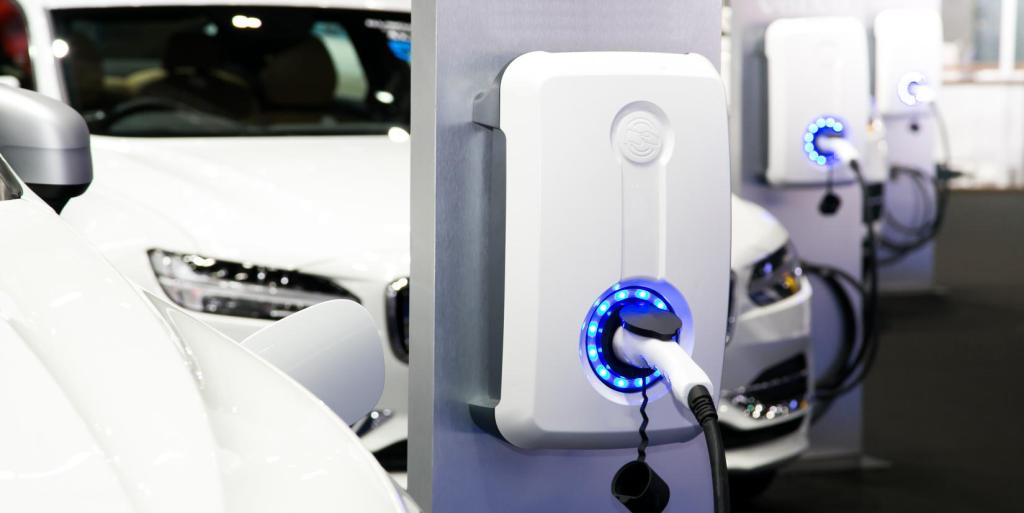
    Rechargeable lithium-ion batteries have been powering the green energy transition in electric vehicles and renewable energy storage. The industry is projected to be worth more than AU$600 billion globally by 2030.

    But current battery technology is facing a major obstacle. Under certain conditions, batteries can become fire hazards.

    A new research program led by Distinguished Professor Guoxiu Wang, Director of the UTS Centre for Clean Energy Technology, aims to put out the fires that have the potential to stall lithium-ion battery uptake.

    His research has been awarded more than $3.6 million in Australian Research Council funding via a five-year Industry Laureate Fellowship.

    Solving a complex problem

    “The current technology is flammable because under certain conditions the liquid electrolyte used in these batteries can combust. This happens when there’s a short circuit or high temperatures during the battery operation process,” Professor Wang says.

    “Our team is aiming to solve this problem through new cutting-edge battery technology that replaces the current liquid electrolyte with a non-flammable gel polymer electrolyte.”

    “But battery technology is very complicated. There are three main components of a lithium-ion battery – the cathode, anode and electrolyte – and all three work together in a complex system.”

    “We need to synchronise the development of new high-performance customised materials for all three components at once. If we just do the electrolyte itself, it won’t work,” he explains.

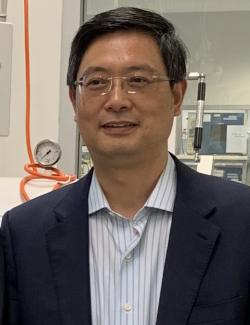
    Photo of Professor Guoxiu Wang
    Distinguished Professor Guoxiu Wang

    Professor Wang’s team has already laid the groundwork to get the balance right between the three types of material. Additional fireproof materials and gels have also been included in their batteries to further improve their safety performance. 

    The team have demonstrated a proof-of-concept of their ground-breaking batteries in the laboratory.

    Through this fellowship, we’ll have the funding to scale up our new technology, optimise it and apply it to large-scale batteries in manufacturing.
    – Distinguished Professor Guoxiu Wang

    “At the same time, we’ll collaborate with our industry partners to improve the overall performance of the batteries such as their energy density and lifecycle.”

    Powering the green energy transition

    Professor Wang’s team isn’t doing this work alone. They are partnering with several battery innovation and manufacturing companies to develop the cathode and anode materials.

    Another industry partner will help manufacture prototype batteries that can then be used in several real-world applications.

    “Each of our industry partners will play a different role in developing and commercialising the technology,” he says.

    “We also have two partners who will adopt our technology and help demonstrate its effectiveness.”

    “At the end of the day, we want to build up the sovereign battery manufacturing capability in Australia: that’s our ultimate objective,” Professor Wang says.

    “If we can manufacture better batteries – batteries with improved performance, energy density and safety features – then we can power up electric vehicle use and renewable energy storage.”

    The prestigious Industry Laureate Fellowships scheme creates a pathway to support academic researchers to work with industry with the aim of increased two-way mobility and skill-building in research collaboration, translation and commercialisation.

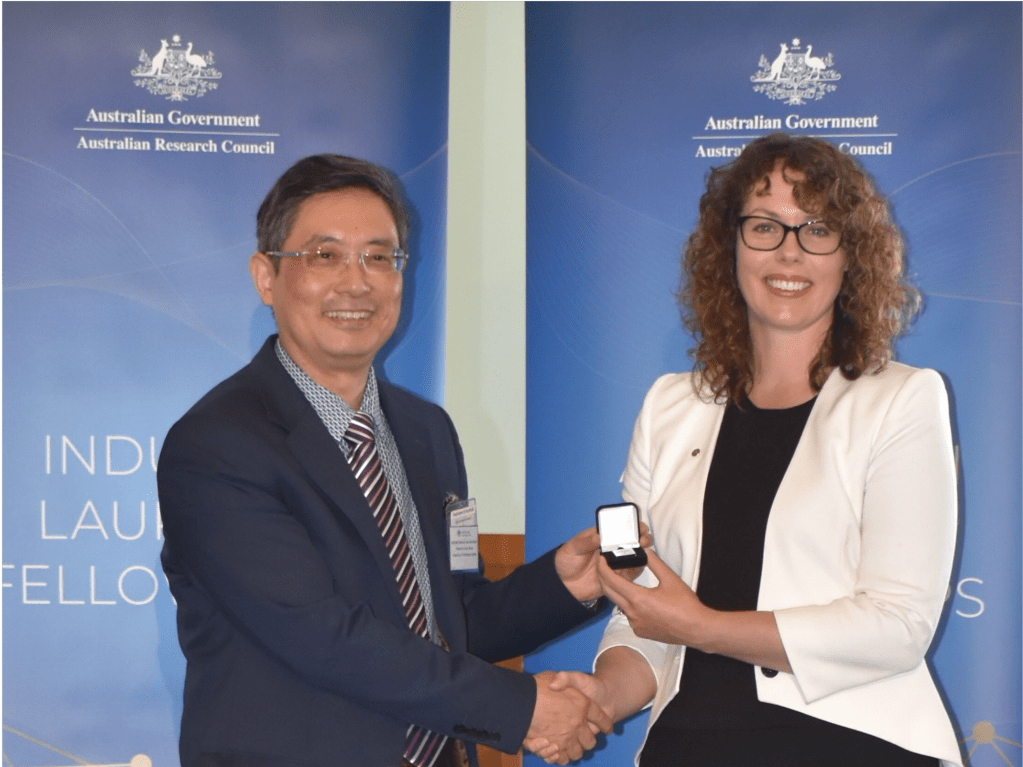
  • Professor Guoxiu Wang Honored with 2024 ARC Industry Laureate Fellowship

    Professor Guoxiu Wang Honored with 2024 ARC Industry Laureate Fellowship

    January 14, 2025 — Sydney, Australia

    The Australian Research Council (ARC) has proudly announced Professor Guoxiu Wang as a recipient of the prestigious 2024 ARC Industry Laureate Fellowship. This fellowship recognizes Professor Wang’s outstanding contributions to advancing clean energy technologies and his pivotal role in fostering collaborations between academia and industry.

    As one of Australia’s leading experts in energy storage and materials science, Professor Wang’s innovative research has significantly influenced the development of high-performance batteries, sustainable energy systems, and cutting-edge nanomaterials. His work is driving Australia’s progress toward a cleaner, greener energy future.

    The Industry Laureate Fellowship provides targeted support to researchers who are not only global leaders in their fields but also actively engage with industry partners to deliver impactful solutions. Professor Wang will leverage this fellowship to further enhance Australia’s capabilities in renewable energy technologies and accelerate the translation of research into practical applications.

    In partnership with key industry stakeholders, Professor Wang aims to address critical challenges in energy storage, including enhancing battery efficiency, reducing costs, and improving sustainability. His efforts will contribute to strengthening Australia’s position as a global leader in renewable energy innovation.

    The ARC’s Industry Laureate Fellowship program highlights the importance of fostering collaboration between researchers and industry, enabling the delivery of tangible benefits to society and the economy. Professor Wang’s groundbreaking work exemplifies the transformative potential of these partnerships.

    For more information about the ARC Industry Fellowships and Professor Guoxiu Wang’s profile, visit the ARC website.